



I left my old post below so if you want, you can see what has changed or how my thoughts on this have evolved.
Tank vs. Tankless Water Heater: An Honest Cost & Lifespan Comparison
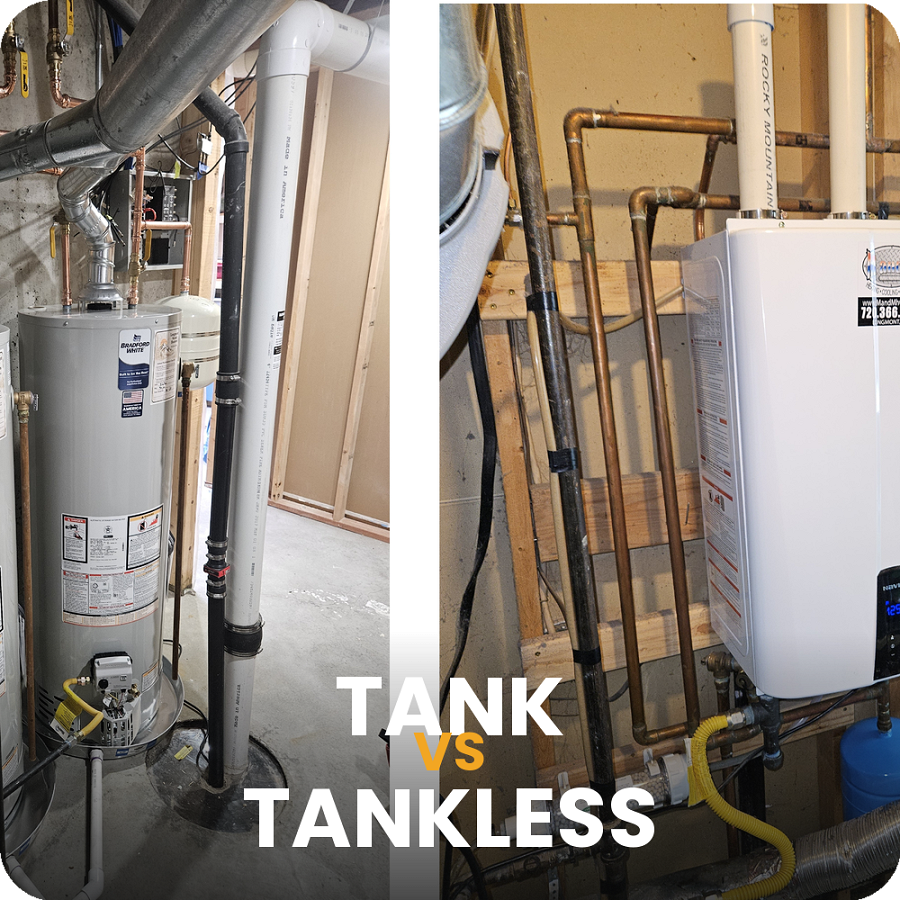
If you're replacing a water heater in Longmont or anywhere along the Front Range, you've probably run into two very different answers online: tankless water heaters are "the future," or tank water heaters are "all you need." The truth is more specific than either headline — and it comes down to real numbers, not marketing.
Below is a straight comparison of tank and tankless water heaters, including actual installed pricing, expected lifespan, energy use, and the tradeoffs nobody puts in the brochure.
Quick Answer: Which Should You Choose?
- Choose a tank water heater if you want the lowest upfront cost, simple maintenance, if your basement is already finished and install would be invasive, or it you want electrical to change.
- Choose a tankless water heater if you have high hot water needs, want endless hot water, have easy access to an exterior wall, and are willing to pay more upfront for a longer-lasting system with strict annual maintenance.
Tank vs. Tankless Water Heater: Comparison Table
| Factor | Tank Water Heater | Tankless Water Heater |
|---|---|---|
| Upfront cost (installed) | ~$2,500 for a 50-gallon gas swap | ~$5,500+ for a swap |
| Lifespan | 10–15 years with annual maintenance | Up to 20 years or more with annual maintenance |
| Storage capacity | 40-75 gallons | None — heats on demand |
| Flow rate limit | Not applicable (tank runs dry) | ~4 gallons/minute in most homes around the front range |
| Space needed | Floor space, dedicated area | Wall-mounted, compact |
| Electricity required | No (atmospheric vent models) | Yes — even gas tankless units need a regular 110v outlet within 6 feet |
| Energy use | Continuous standby heat loss | Higher gas draw per use, no standby loss |
| Hot water delay | Immediate | About 5 seconds slower to fixtures |
| Maintenance needs | annual flush ($150) is recommended, very few moving parts | Tankless annual flush ($350) much more strict adherence required, lots more moving parts |
Cost Comparison: What You'll Actually Pay
This is where most comparison articles get vague. Here's what real installs look like with Longmont Water Heaters:
- Tank water heater (50-gallon gas swap): around $2,500
- Tank-to-tankless conversion: at least $5,500
That's roughly a $3,300 premium to go tankless. Tankless units do burn gas more efficiently per gallon since they don't sit there reheating stored water all day — but if financials are the only consideration, a tank will still be cheaper, even over a 20-year tankless lifespan, most households won't recoup that cost difference in natural gas savings alone. If you're going tankless, do it for endless hot water, and more efficiency — not because you expect it to pay for itself.
Lifespan Comparison
- Tank water heaters typically last 10–15 years with annual maintenance.
- Tankless water heaters can last up to 20 years or more — but only with consistent annual maintenance.
Tankless units have more moving parts: fans, pumps, and a heat exchanger. That means more potential component replacements over the system's life, and tankless systems are less forgiving if you skip a service year. A neglected tankless unit won't necessarily last longer than a well-maintained tank — it may fail sooner.
Energy Efficiency: The Part Most People Get Wrong
Tankless water heaters don't use less gas — they actually pull more gas per use. What makes them more efficient is that they don't run around the clock like a tank does. A tank continuously reheats stored water, and although they are getting more and more insulated, and have less and less standby heat loss, it still maintains temp 24-7 on the off chance you might want hot water at 3:30am A tankless unit only fires up when you turn on a hot water tap.
Net result: tankless typically wins on energy efficiency over time, but the savings are gradual, not dramatic — see the cost section above for why that rarely offsets the higher install price.
(One exception worth a future deep dive: heat pump tank water heaters, which behave very differently on efficiency.)
Space and Installation Requirements
- Tank water heaters need floor space — a utility room or dedicated storage area.
- Tankless water heaters mount on a wall, which saves floor space but requires an actual wall. They can't just sit in the middle of an unfinished basement.
- Electrical outlet: Every tankless unit needs a nearby power outlet — even gas-fired models. No extension cords; the outlet needs to be within 5 feet of the unit. Traditional atmospheric vent tank water heaters, by contrast, often need no electricity at all.
Hot Water Capacity and Flow Rate
- A tank water heater delivers a large volume of hot water immediately, until the tank runs out.
- A tankless water heater delivers hot water endlessly, but only up to a flow rate limit — typically around 4 gallons per minute in this area. Running multiple showers and appliances at once may require a larger unit or a second tankless system.
Response Time
Tank systems deliver hot water instantly since it's already heated and stored. Tankless systems take a few extra seconds — typically about 5 seconds — to heat water as it flows through the unit.
Tank vs. Tankless: Which Is Right for Your Home?
- Go tank if you want lower upfront cost, simple installation, and reuse the space the current tank sits in
- Go tankless you want an endless hot water supply, if you have a large soaking tub or similar fixture that just needs more hot water than a tank can provide, and you're comfortable with the maintenance schedule and the added cost overall.
There's no universally "better" option — only the better option for your household's hot water demand, budget, and space.
Frequently Asked Questions
Is a tankless water heater worth the extra cost? It depends on your priorities. Tankless costs about $3,300 more upfront than a tank swap in this area. You'll see some energy savings over time, but even over a 20-year lifespan, most homeowners won't fully recoup that gap through gas savings alone. The value is in the space savings and endless hot water, not payback period.
How long does a tankless water heater really last? Up to 20 years or more, but only with annual maintenance. Skipping maintenance shortens its life significantly since tankless units are more sensitive to mineral buildup and component wear than tank units.
Do tankless water heaters need electricity? Yes. Every tankless unit — gas or electric — needs a power outlet within 5 feet, with no extension cords. This surprises a lot of homeowners switching from an old atmospheric vent tank that never needed a plug.
Will a tankless water heater run out of hot water? Not in the way a tank does, but it has a flow rate limit — around 4 gallons per minute locally. Heavy simultaneous use (multiple showers plus a dishwasher, for example) can still exceed that.
Have questions about which system fits your home? Call Longmont Water Heaters at (970) 389-2285 and we'll walk through the real numbers for your household.
Written by Mike Stahlman and Claude, Longmont Water Heaters. Serving Longmont, Niwot, Mead, Berthoud, Erie, Frederick, Firestone, Dacono, and Lyons, CO.